Werewolf Fertility Crisis
Insatiable Box Set: Books 1-4The Werewolf Fertility Crisis is the novel’s persistent population emergency: most werefemales are sterile, and even when werewolves mate with females, pups may not be conceived or born alive. The crisis makes reproduction a matter of pack survival and political power, shaping marriage, leadership, and the treatment of women. The possibility of fertility returning through Mena’s pregnancy offers hope, but the story also shows how that hope can make women’s bodies objects of strategy and control.
Origins and Demographic Stakes
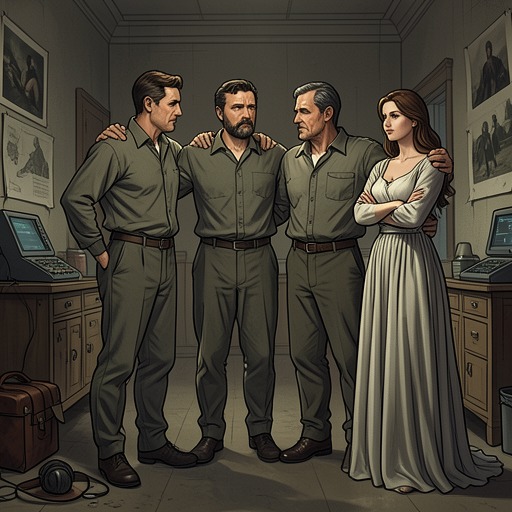
The crisis is described as widespread rather than individual. Wilder explains that most werefemales are sterile, and the Samsa brothers’ search for a mate has an explicitly reproductive dimension: Wilder wants a family, but cannot find a compatible female werewolf who is fertile and would accept his brothers as mates. Because Wilder, Drayton, and Lycell are triplets and Alpha wolves, they have pledged to remain together and share authority over the territory inherited from their father. They will neither drive one another out nor divide their unity over a mate. Their solution therefore depends on finding one woman able to bear pups for the brothers’ shared family.
This private difficulty reflects a larger decline. The packs Wilder polices are dwindling, and he convenes a council to consider how to address the shortage of breeding. Rather than capture human women, he refuses to begin a practice that he fears would expose werewolves to human retaliation and destruction. He instead hopes that money will attract women willing to meet him and his brothers. Some women choose to live with other pack members, while Wilder waits for a suitable partner. The strategy combines a real attempt to avoid abduction with a system in which one woman’s fertility is expected to serve an entire pack’s future.
The crisis also threatens the Samsas’ political position. Wilder’s sons, Hunter and Devin, are coming of age, but the pack still lacks enough young werewolves to withstand the older fighters in Ramsey’s pack. Mena explains that Ramsey intends to destroy the Samsas and their offspring after learning that Drayton and Wilder gave refuge to her and Robert. In this conflict, the number of living young werewolves is not merely a family concern: it determines whether the Samsas can defend their leadership and prevent war.
Human Fertility as a Contested Resource
Adrienne’s pregnancy makes the demographic problem newly visible to rival packs. Wilder reports that a beta warned him that Bane’s pack in Oregon wolf territory had heard the Samsa brothers had impregnated a human woman. Her youth and fertility make her appear to their opponents as a potential source of many future fighters; the warning estimates that, if Drayton also gets her pregnant, the Samsa pack could eventually reach twenty fighting males. The fear that this growth would secure Samsa dominance across North America and Europe turns Adrienne’s pregnancy into a military and political stake. Drayton offers to accompany her into town, but Adrienne refuses his attempt to decide for her, asserting that she can look after herself and Mena.
Mena’s experience shows how those reproductive politics intersect with gendered rules. She had lived under her father’s authority and the laws governing werefemales, whose lives depended on the Alpha’s goodwill and whose worth was measured by bearing pups. Her father intended to marry her to the more powerful Drayton, but she fell in love with Robert instead. He was a human doctor, and her father needed his care for a diminishing pack; all its females, including Mena, were believed sterile. Mena’s marriage to Robert thus diverges from the marriage her father planned, while also connecting a human household to the pack’s survival.
The book contrasts this relationship with the abuses that have accompanied other attempts to secure reproduction. Bane had allowed his werewolves autonomy and promised not to interfere with their treatment of females, even as Wilder imposed strict laws concerning women. The narrative describes male werewolves as abusive toward both human women and werefemales: human women were sent back to their families barely able to function, and werefemales in Bane’s pack were treated even worse. Such matings often produced no living pups. Where fertile women were scarce, some packs passed them among young and old males, hoping to impregnate them and continuing until the women were depleted. The supposed remedy for dwindling numbers therefore reproduces violence and fails even on its own terms.
Mena’s Pregnancy and the Serum
The most direct challenge to the assumption that werefemales must remain sterile comes through Mena. She tells Adrienne that she and Robert are expecting a baby, or possibly babies, after Robert gave her an experimental drug he had been developing. Mena had believed herself sterile; her pregnancy changes what the characters think may be possible. The text does not establish a completed cure or a guaranteed result for other werefemales, but it does present this pregnancy as evidence that fertility may be recoverable.
Robert’s work is framed as an effort to reverse sterility rather than simply to investigate it. He has developed a serum intended to counteract the condition and prevent future females from becoming sterile. The treatment remains experimental, and Robert expects side effects without knowing what form they may take. Mena is nevertheless happy to discover that she is pregnant. The uncertainty matters: her pregnancy is a hopeful outcome, but it does not erase the medical risks or establish that every infertile female can be treated successfully.
Adrienne asks whether the treatment could work on males, since Drayton fears that he may be infertile. She recognizes that werewolves are a different species and that Mena’s result cannot answer the question by itself. The narrative supplies no confirmation that the serum addresses male infertility. This distinction keeps the crisis broader than one successful pregnancy: Mena’s conception offers proof of possibility, not a settled solution to every reproductive obstacle.
Marriage, Alliances, and Pack Policy
Fertility shapes the Samsas’ arrangements as well as their opponents’ plans. Adrienne eventually tells Wilder that she wants to marry him, Lycell, and Drayton, reversing her earlier opposition to becoming the brothers’ shared mate. The choice fits the family structure Wilder had described, but her demand that the relationship be made a marriage also gives her language for setting terms within it. The brothers’ arrangement is presented both as a response to their unity and as a means of producing the pups on which the pack’s future depends.
The political pressure extends to Drayton and Mena. Wilder tells Drayton that he must mate with Mena to keep the werewolves from war; Drayton objects that he does not love her, while Wilder answers that the decision is about preventing conflict, not romance. The proposed pairing makes the reproductive crisis inseparable from diplomacy: a mating can be treated as a political instrument, even when the person expected to enter it objects. Later, Wilder tells Robert that he sanctions Robert’s marriage to Mena and welcomes him to remain as the Samsas’ doctor. He connects the couple’s future to his plan to travel with his sons to Oregon and stop the uprising, while Robert says Devin will be able to travel in two weeks. The marriage is therefore not simply a private resolution; it sits within a fragile effort to manage pack relations and family security.
Bane’s response further exposes the contradiction between reproductive law and personal desire. He had previously opposed bringing human females into werewolf packs, considering them inferior to werewolf unions, and had accepted the idea that humane treatment of humans was required by werewolf law. Once Adrienne is pregnant, however, the rule against killing a female—especially a pregnant one—constrains his actions. He becomes captivated by her and sees her as a possible mate who might bear his pups, although his pack has never had pups born because its werefemales are sterile. He later tells her that he does not care about the Samsas’ pups but does care about her; the crisis has made a human woman at once a political asset, a protected captive, and the focus of his fixation.
Meaning and Consequences
The crisis governs the novel by converting reproductive capacity into a measure of collective survival. Pups promise future defenders; pregnancies alter alliances; and sterility can redirect marriage plans or invite coercive intervention. The same demographic fear produces opposing policies: Wilder tries to attract women rather than abduct them and enforces strict laws on their treatment, while Bane permits his pack autonomy despite its abuses. Neither approach removes the underlying scarcity, and the narrative shows that violence against women can damage the people it is meant to make more numerous.
Mena’s pregnancy with Robert’s help and Adrienne’s pregnancies with the Samsa brothers give the declining packs concrete grounds for hope, but they do not resolve the crisis once and for all. Adrienne’s expected pups are treated by rival werewolves as a threat to the balance of power, while Robert’s experimental serum offers an uncertain medical possibility. The crisis thus remains both biological and political: a question of whether pups can be born, and of who gets to decide which relationships, bodies, and futures will be organized in the name of producing them.